

Extremadura,
Spain Travel & Accommodation Guide
Mérida
Hotels, Extremadura, Spain
|

|
| Mérida
- capital of
Extremadura, and a Roman city in Spain. Established by the Romans in 25
BC, Mérida has an extensive collection of Roman ruins and a museum
devoted to Roman history. The Roman Theatre is well worth a visit.
A walk around Mérida takes you to amazing sites of Roman origin. |
Merida,
Extremadura. A Roman Town
420 kilometres north of the Costa
del Sol, in Extremadura, is the small town of Merida. It is too far for
a day trip and in any case there is far too much to see in one day so try
for one of the 50 Euro per night offers at the Medea Melia Tryp which is
about 20 minutes walk from the centre of the town. Merida is remarkable
in that its history dates back to Roman times and being in a remote, less
well-known part of Spain, has not been developed to any great extent....
read
more |
|
View
Extremadura
map - Return to Extremadura Home
Page
|
|
Extremadura
Photo Gallery - Paradores
of Extremadura
|
|
Buy
at AllPosters.com

MÉRIDA
FEATURED HOTELS, EXTREMADURA, SPAIN |
|
Search
for more hotels in Mérida
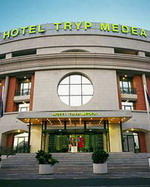 |
Hotel
Tryp Medea, Mérida
The Tryp Medea hotel is
located in the area surrounding the old Roman bridge, an obligatory stop
in the Silver route. Close to a shopping center. The building, in semicircular
shape, is similar to a Roman Amphitheatre. Restaurants and bars:
Breakfast buffet (from 7.30am to 10.30am), Bar (open from 10.30am until
midnight). Room Service and Wireless Internet Access in common areas
(additional charge), Air conditioning throught the building and parking.
Outdoor swimming-pool open in summertime. 103 Standard rooms.
23 Loft rooms of superior standard, situated on the 4th floor, equipped
with a whirpool, spacious terrace, free newspaper and mini-bar. |
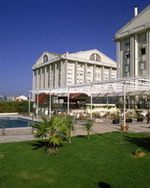 |
Hotel
Velada Mérida
This attractive hotel is
in the tourist centre of Mérida, close to the Roman Ampitheatre,
the theatre, National Museum of Roman art and many more interesting touristic
attractions. E Alcazaba, the restaurant in the hotel offers many
specialities of the region and city. In front of the hotel public
transport is available. The hotel has 99 rooms, 3 suitable for handicapped
guests. All rooms have air conditioning, minibar, trouser press,
free wifi internet connection, service and direct telephone - en suite
bathroom |
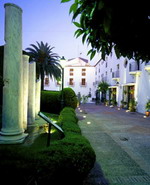 |
Parador
de Mérida, Mérida
The Hotel retains the structure
of the former 18th century convent, built over the remains of a temple
to the Concord of Augustus. It offers guests an opportunity to enjoy the
rich heritage of the lovely city of Mérida and the landscape around
it. Some of the most outstanding spaces are the hotel lounge in the
former convent refectory, the interior courtyard and the beautiful gardens,
including the “Garden of Antiquities”, an archaeological collection consisting
of Mudejar, Roman and Visigoth elements. Taste the exquisite local
dishes, including caldereta (lamb stew), assorted gazpachos, figs from
Almoharín and naturally, truffles. |
Merida,
Extremadura. A Roman Town by Nick Nutter
420 kilometres north of the
Costa del Sol, in Extremadura, is the small town of Merida. It is too far
for a day trip and in any case there is far too much to see in one day
so try for one of the 50 Euro per night offers at the Medea Melia Tryp
which is about 20 minutes walk from the centre of the town. Merida is remarkable
in that its history dates back to Roman times and being in a remote, less
well-known part of Spain, has not been developed to any great extent. Consequently
there are still many traces of what was once one of the most important
Roman and Islamic cities in the peninsula.
| Augusta Emerita was founded
in 25 BC for retired Italian soldiers who had fought in the Cantabrian
war. It was also intended to be the capital of the recently (27 BC) created
province of Lusitania. Its location made it a communications centre where
roads from Lisbon (Olisipo), Astorga (Asturica), Toledo (Toletum), Cordoba
(Corduba) and Seville (Hispalis) all met. The Medea Hotel is an excellent
place to start an exploration of Augusta Emerita. Even the hotel itself
is built in a 'Roman amphitheatre' style and is alongside one of the main
Roman roads that led to the city allowing us to march smartly down to the
Roman bridge. Recently pedestrianized, the bridge has been in constant
use for over 2000 years. Repairs over the years have been in keeping with
the original style and the majority of it is original. It is one of the
finest examples of Roman architecture in the peninsular. Sixty arches carry
the bridge across the river to the south gate into the city. On the right
of the gate are the original walls. Those to the left have been demolished.
It is easy to imagine the legionnaires breathing a sigh of relief after
marching from Portugal with their destination in sight. |

The
Roman Arena, Merida, Extramadura, Spain
Buy
at AllPosters.com
|
Once in the city the choice
of destinations is daunting. To cover the Roman period a visit to the amphitheatre
and theatre is a must. The theatre is the best example of its kind in western
Europe. Next to the theatre is the amphitheatre. Built in 8 BC it is also
an excellent example with many of the passages below the seating still
in their original form. The pit in the floor was where gladiators and wild
animals were kept prior to their 'performance'. Many people are confused
by the words theatre and amphitheatre, expecting the latter to be a semi
circle and the former to be round. During the early part of the Roman Empire
gladiatorial games to the death and pitting man against beast were popular
entertainments. These took place in the round amphitheatre. Later, during
the Imperial period, plays and music became popular and for these purposes
the semi circular theatres were built.
A visit to the Museum of
Roman Art near the theatre is also a must. Here you can see the usual glass,
coins, statues and other artefacts found during excavations but the two
highlights are the fine mosaics, and the examples of Roman water technology.
Some of the mosaics are huge and extremely well preserved. Romans were
as class conscious as any other people and mosaics were used to impress
friends and neighbours. The smaller each individual tile in the mosaic
the more detail can be achieved with consequential increases in cost.

Roman
Bridge, Merida, Extremadura, Spain
Buy
at AllPosters.com
|
It is the technology that
really impresses. Huge bronze valves used to isolate sections of water
piping for maintenance, valves to control the rate of flow of water and
one-way valves. A detailed video, also available for sale, shows how the
Romans understood and used water pressure to move water vertically as well
as horizontally. Given a few more years they could easily have invented
the steam engine. It is easy to realise how the uneducated Visigoths, who
replaced the Romans, found the technology incomprehensible and thus failed
to maintain it.
When wandering around Merida
it is impossible not to notice other examples of Roman architecture. There
is an arch, still in use, monumental aqueducts, bath houses unearthed beneath
demolished buildings from a later era and many examples of original walls
still used in current buildings. |
Breathtaking it may be but
you still have to keep body and soul together. Fortunately there is no
shortage of watering holes. Menu del Dia is definitely the way to go here
and if you get the chance try the ham. Extremadurans claim their ham is
superior to Serrano, and they are right.
A favourite form of entertainment
during Roman times took place at the Hippodrome or circus. The one at Merida
is one of only three known in Spain, the other two are at Toledo and Tarragona.
Built in an oval shape, over 400 metres long and 150 metres wide, the Merida
circus could seat 30,000 people, almost the entire population. They were
treated to chariot races, seven laps with no rules other than the winner
was the first across the finishing line. Champions were venerated, there
were no prizes for coming second and accidents were common. The chariots
were as light as possible and pulled by two or four horses. They entered
the ring at the start of the race via starting gates situated in a line
at one end of the circus, very similar to the start of a modern horse race
today, and thundered around the central platform that was called a spina.
On occasion the entire circus could be flooded to enable re-enactments
of naval battles.
The huge amount of water
required to flood the arena would have come from the aqueduct that passes
the western end of the circus. This is the Acueducto de San Lazaro and
it is impossible to miss it. The arches supporting the water channel march
off for well over a kilometre towards the hills north of the city. Notice
how at the circus end modern buildings abut the aqueduct. There are not
many houses with a finer arch at the end of the drive than the one here
at Merida. Recently excavated beneath the aqueduct is the site of a public
baths area and a sports area, a Roman desportivos.

Lampposts
on a Roman Aqueduct, Merida, Badajoz, Spain
Buy
at AllPosters.com
Walking back into town you
will next arrive at the Casa del Anfiteatro that is a whole site in its
own right. The south section of the aqueduct emerges here and there is
a water tower with a house alongside. Inside the house you will find some
wonderful mosaics.
From there it is a short
walk to the south end of town, near the bullring. You will come to a site
called Columbarios, which is a Roman cemetery. Two of the vaults have been
identified as belonging to the Julius family and the Voconius family. The
cemetery would have been situated outside the city walls as was customary
at the time. The epigraphs and portraits have survived. Leaving the cemetery
you will arrive at the Casa del Mitro. This was a large villa also situated
outside the city walls. Some wall decorations and mosaics have survived
along with the foundations, an extensive bath house and a huge underground
water cistern.
To really take away an idea
of what life was like around the 1st century AD then a visit to Moreria
is essential. This is a 12,000 square metre site behind the city wall alongside
the river north of the Roman bridge. Originally it was an urban area, the
houses, large and small are there to see, with a section of the east west
main road through the town. It is easy to imagine this bustling street
with covered arcades on each side housing shops and taverns. Four minor
roads lead off and penetrate the city walls to give access to the river.
This site is particularly important for revealing a continuous history
of occupation from Roman, through Visigoth to Moors and then Christians,
each leaving their layer for us to find.
Top
Merida
Hotels
|
| About the Author - Nick
is the editor of a magazine on the Costa del Sol, Andalucia
Life |
|
|
