Jaén
& Jaén Province Locations:
Jaen
Province Hotels -
Baeza
-
Cazorla
-
Jaen
-
Torres
-
Ubeda
- BAEZA
FEATURED HOTELS, JAEN PROVINCE, ANDALUCIA, SPAIN
|
|
 Baeza
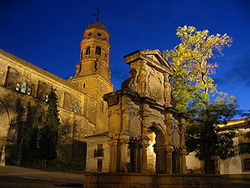
is a town of approximately 15,000 in Andalusia, Spain, in the province
of Jaén, perched on a cliff in the Loma de Baeza, a mountain range
between the river Guadalquivir on the south and its tributary the Guadalimar
on the north. The town has existed since Roman times, when it was called
Beatia, but it is chiefly known today as having many of the best-preserved
examples of Italian Renaissance architecture in Spain. UNESCO added Baeza
and Ubeda to the World Heritage Sites list in 2003. Baeza
is a town of approximately 15,000 in Andalusia, Spain, in the province
of Jaén, perched on a cliff in the Loma de Baeza, a mountain range
between the river Guadalquivir on the south and its tributary the Guadalimar
on the north. The town has existed since Roman times, when it was called
Beatia, but it is chiefly known today as having many of the best-preserved
examples of Italian Renaissance architecture in Spain. UNESCO added Baeza
and Ubeda to the World Heritage Sites list in 2003.
In the Middle
Ages Baeza was a flourishing Moorish city, said to contain 50,000 inhabitants,
but it fell to the forces of Ferdinand III of Castile in 1227. The Cordova
and Úbeda gates, and the arch of Baeza, are among the remains of
its Moorish fortifications.
In the 16th
century, Baeza and nearby Úbeda grew rich from the production of
textiles, and local nobles hired important architects, such as Andrés
de Vandelvira, to design new palaces, churches and public squares in the
fashionable Italian style. The economy collapsed in the 17th century, which
had the fortunate side effect of preserving Baeza's Renaissance architectural
legacy, because few newer structures were built. Baeza appears much more
Italian than Spanish, with an unusual sense of lightness, order, and proportion.
Baeza's chief
Renaissance structures are the university, established in 1538, which is
now a summer school for the University of Granada, the Catedral de Santa
María, the Palacio de Jabalquinto, and the squares of Plaza de España
and the Paseo de la Constitucíon. All of these sites are located
within walking distance of each other, in what is called the Zona Monumental.
Baeza is 327
km (203 miles) by highway south of Madrid. It has a RENFE rail station
(Linares - Baeza) 9 miles southwest on the Linares-Almeria railway and
bus transportation from Granada, Málaga and Madrid. The nearest
international airports are in Granada, 132 km (82 miles) south and Málaga,
241 km (150 miles) to the southwest.
Search
for hotels in Baeza
|
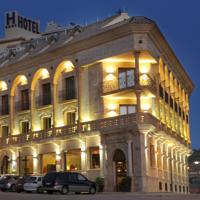 |
Hotel
Campos de Baeza, Baeza
Hotel Campos de Baeza is
located in the historic town of Baeza in Jaen, Spain. It lies one kilometre
from the Baeza Cathedral, and 1.5 kilometres from the Arabic Baths.
This seven-storey hotel has classical styling with modern touches, and
multilingual staff at the 24-hour front desk can offer concierge services
and tour assistance. The hotel's air-conditioned public areas
offer wireless internet access, and there is garage parking for a surcharge.
Restaurant Asador Campos de Baeza serves regional specialities and Mediterranean
dishes, in a contemporary room with traditional styling. |
Continue
browsing accommodation in Baeza
- CAZORLA
FEATURED HOTELS, JAEN PROVINCE, ANDALUCIA, SPAIN
|
|
 Cazorla
is a city located in the province of Jaén, Spain. According to the
2006 census (INE), the city had a population of 8,173 inhabitants. Cazorla
is a city located in the province of Jaén, Spain. According to the
2006 census (INE), the city had a population of 8,173 inhabitants.
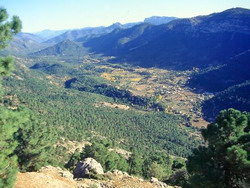
Cazorla lies
at an elevation of 836 metres on the western slope of the Sierra de Cazorla.
It is the entry point and base for visits to the Natural Park of Sierras
de Cazorla Segura y las Villas, a vast protected area of magnificent river
gorges and forests. Spain's second longest river, the Guadalquivir has
its source in the mountains to the south of the settlement.
Distances to
nearby cities are: Jaén, 121 km.; Granada, 205 km.; and Linares,
71 km. See Mapa de Carreteras de Jaén
The town is
constructed around three main squares, the Plaza de la Constitución,
the Plaza de la Corredera (or de Huevo, "of the Egg", because of its shape),
and the Plaza Santa Maria. This last square is the oldest and is connected
to the other two by narrow, twisting streets. It takes its name from the
old cathedral which, damaged by floods in the seventeenth century, was
later burnt by French troops. It is now in ruin. Above the square sits
an austere, reconstructed Moorish castle tower called la Yedra. Still higher
up on the rocky escarpment lie the ruins of still yet another ruined fortress.
A recommended
excursion is to the nearby village of la Iruela which has a ruined Moorish
fortress perched on a daunting rock peak. A number of battles were fought
here during the Reconquest until Don Rodrigo Jimenez de Rada, archbishop
of Toledo, reconquered it in 1231 and made it the seat of his archbishopric.
Its primitive
structure is relatively intact. The principal defenses consist of a crumbling
principal tower and two separate enclosures, with some of its battlements
still intact, connected by a long curtain wall. These walls also protected
the monastery, whose remains are still visible nearby. See Castles
The history
of Cazorla goes back more than two thousand years. Under the Romans the
town had the name of Carcacena. Not only were there significant Iberian
and Roman settlements here, but this was also the see of one of the first
bishoprics of early Christian Spain. Under the Moors it was a strategic
stronghold and one of dozens of fortresses and watchtowers guarding the
mountains. Taken after a bitter struggle in 1235, during the Reconquista,
the town then acted as an outpost for Christian troops.
Today Cazorla
is heavily dependent on tourism and hosts events such as the Cazorla Blues
Festival each July. There is also production of high-quality olive oil
from the one third of municipal land planted in olive trees. There is even
a publication, The Olive Oil Gazette, which is published in Cazorla. Sierra
de Cazorla is the Denomination of Origen for this olive oil. See Sierra
de Cazorla. The town celebrates its annual fair in mid-September.
For such a
small town there are a surprising number of three and four star hotels
and countless rural guest houses.
Winter nights
can be cold due to the elevation but snow is infrequent. Summers are cooler
than the low-lying plains to the west and the town fills with tourists
during the summer months. |
Search
for hotels in Cazorla
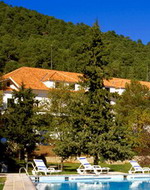 |
Parador
of Cazorla, Cazorla, Jaén
Charming hotel in the heart
of nature - The Hotel is located in the Heart of Cazorla Nature Reserve,
in the spot known as Sacejo. Its high location means it benefits from unbeatable
panoramic views over the surrounding area with its abundance of pine-filled
hillsides typical of the mountains. The quiet atmosphere and beautiful
enclaves such as Cañada de las Fuentes or Linarejos waterfall make
it a meeting spot for nature lovers. The hotel follows typical Andalusian
farmhouse tradition, highlighted to the exterior. The swimming pool has
marvellous views out over the Nature Reserve and the pleasant lounge with
its chimney breast to the inside is characterised by the bright light streaming
in through the large windows. Seasonal game forms part of the cuisine available
at the restaurant with dishes such as wild boar in red wine and grilled
venison fillets. |
Continue
browsing accommodation in Cazorla
- JAEN
FEATURED HOTELS, JAEN PROVINCE, ANDALUCIA, SPAIN
|
|
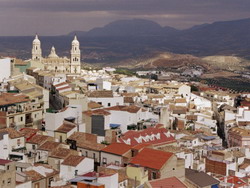 Jaén
is a city in south-central Spain, the name is probably derived from the
Arabic word Jayyan, (crossroads of caravans). It is the capital of the
province of Jaén. It is located in the autonomous community of Andalusia.
The inhabitants of the city are known as Jiennenses. Its population is
117,540 (2006), about 1/6 of the population of the province. Jaén
is a city in south-central Spain, the name is probably derived from the
Arabic word Jayyan, (crossroads of caravans). It is the capital of the
province of Jaén. It is located in the autonomous community of Andalusia.
The inhabitants of the city are known as Jiennenses. Its population is
117,540 (2006), about 1/6 of the population of the province.
In the last
years Jaén has had a great increase of cultural tourism. Jaén
is also known as the World Capital of Olive Oil, because it's the biggest
producer of this liquid gold (as the locals refer to it). The urbanism
of Jaén is determined by its adjustment to the hills of the Santa
Catalina mountains, with steep, narrow streets, in the historical central
city district.
The city of
Jaén is the administrative and industrial centre for the province.
Industrial establishments in the city include chemical works, tanneries,
distilleries, cookies factories and textile factories.
Monuments
Jaén
Cathedral, one of the most important Renaissance style cathedrals, began
construction in 1570 and was completed in 1802. It is dedicated to the
Assumption of the Virgin, and it was built to shelter the relic of The
Holy Face, or Veil of Veronica, lodged at the major chapel and exposed
to the public every Friday. Due to the length of time in its construction,
different artistic styles can be appreciated, the most prominent being
Renaissance; Andrés de Vandelvira the most important architect.
He is the greatest exponent of the Andalusian Renaissance. It aspires to
be listed as a World Heritage Site by UNESCO.... read
more |
Search
for more hotels in Jaén
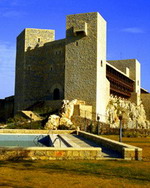 |
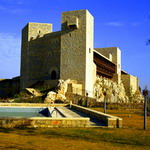
Parador
of Jaén, Jaén
Exceptional
18th Century Arabic Fortress - The hotel's privileged location on the Cerro
de Santa Catalina adds a defensive, fortress-like character to the Jaén
landscape. With a refreshing swimming pool and exterior stonework
that soaks up the sun, the hotel promises to enchant you with a full experience
of the Andaluz Renaissance. The building's majestic appearance continues
inside with the impressive 20 metre high arches in the main hall, the dining
room with its distinctive Arabic character, and the comfortable bedrooms
with their magnificent views. The soft interior decoration of the
building is complemented by a varied gastronomic menu. Try our ajo
blanco, an exquisite dish made with garlic, oil, almonds and bread. And
do not miss the terrina de perdiz (partridge terrine), the pipirrana (typical
salad) and the ciervo al estilo de Baños (venison). |
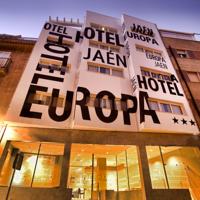 |
Hotel
Europa Jaén
This modern hotel is located
in the city centre of Jaén and features a terrace with views over
the cathedral. It offers rooms with free Wi-Fi, air conditioning, a TV
and private bathroom. The central location of the Europa allows guests
to explore the city and its many monuments by foot. The hotel can organise
bicycle rental and guided tours around Jaén and its neighbouring
cities, Baeza and Úbeda. The property is conveniently located for
those visiting the IFEJA congress site. There is a bus station just 200
m from Hotel Europa, and many restaurants and tapas bars can be found 100
m away. Private parking can be found around 200 m from the hotel. There
is a sports centre with a swimming pool 600 m away. |
Continue
browsing accommodation in Jaén
- TORRES
FEATURED HOTELS, JAEN PROVINCE, ANDALUCIA, SPAIN
|
|
| Torres
de Albánchez is a village located in the province of Jaén,
Spain. According to the 2005 census (INE), the city has a population of
923 inhabitants. |
Search
for hotels in Torres
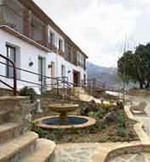 |
Hotel
Rural Puerto Magina, Torres
The
Hotel Rural Puerto Magina is located in Torres, Spain, three kilometres
from the town centre. Jaen is 33 kilometres away and Ubeda is 53 kilometres
away. Surrounded by lush gardens, the Hotel Rural Puerto Magina is
housed in a modern rustic-style property and is perched on a hilltop overlooking
rolling valleys. There are panoramic views from the outdoor pool, and there
is an onsite bar and cafeteria. Puerto Magina restaurant serves regional
and international dishes al fresco on the panoramic terrace. A complimentary
breakfast is served daily. The hotel houses 18 air-conditioned guestrooms
and apartments finished with modern decor, dark wood furnishings and floral
fabrics. |
Continue
browsing accommodation in Torres
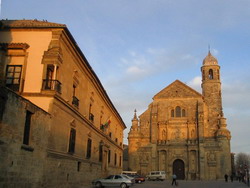 Úbeda
is a town in the province of Jaén in Spain's autonomous community
of Andalusia. It has 34,462 (INE 2008). Both this city and the neighboring
city of Baeza benefited for extensive patronage in the early 16th century
resulting in the construction of a series of Renaissance style palaces
and churches, which have been preserved across the centuries. In 2003,
UNESCO declared the historic cores and monuments of these two towns a World
Heritage Site. Úbeda
is a town in the province of Jaén in Spain's autonomous community
of Andalusia. It has 34,462 (INE 2008). Both this city and the neighboring
city of Baeza benefited for extensive patronage in the early 16th century
resulting in the construction of a series of Renaissance style palaces
and churches, which have been preserved across the centuries. In 2003,
UNESCO declared the historic cores and monuments of these two towns a World
Heritage Site.
The most outstanding
feature of the city is the monumental Vázquez de Molina Square,
surrounded with imposing Renaissance buildings such as the Palacio de las
Cadenas (so named for the decorative chains which once hung from the façade).
The Chapel of the Savior or Capilla del Salvador was constructed to house
the tombs of local nobility. Both the interior and exterior are decorated;
for example, interior has an elaborate metawork screen by the ironworker
Bartolomé de Jaen. The Hospital de Santiago, designed by Vandelvira
in the late 16th century, with its square bell towers and graceful Renaissance
courtyard, is now the home of the town's Conference Hall. Ubeda has a Parador
hotel, housed in a 16th century palace which was the residence of a high-ranking
churchman of that period.
The town lends
its name to a common figure of speech in Spanish, andar por los cerros
de Úbeda (literally 'to walk around the hills of Úbeda'),
meaning 'to go off at a tangent'. |
Search
for hotels in Ubeda
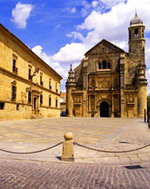 |
Parador
of Úbeda, Jaén Province
16th
Century renaissance palace - in the aristocratic, monumental city of Úbeda,
in its purest Renaissance plaza and next to some of its most beautiful
buildings, the Parador occupies a palace, built in the 16th century and
remodelled in the 17th, which once belonged to the Dean of the Holy Chapel
of the Saviour. Behind the façade is a very beautiful inner
courtyard, with a double gallery, the upper tier of which is glazed. The
comfortable and welcoming rooms are remarkable for the height of their
ceilings. Particularly outstanding are the six looking onto the plaza,
and the suite on the opposite corner, with panoramic views of the Plaza
de Vázquez de Molina. Sit down in the Parador’s dining room,
take up a menu and enjoy. Bull’s tail in loma red wine, stewed kid with
pine nuts, peppers stuffed with partridge… Whatever you order, success
is assured. Andalusian details and ceramics decorate the dining room. |
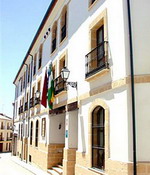 |
Sercotel
Rosaleda de Don Pedro, Úbeda
Hotel
Rosaleda Don Pedro lies in the centre of the city of Ubeda, Andalucia,
Spain, 100 metres from the attractions of the old town. Those include the
archaeology museum of the Mudéjar House (50 metres away) and the
historic square, Plaza Vazquez de Molina (100 metres away). This
three-storey hotel was built in the 16th century in traditionally Spanish
style. It features an inner courtyard with a sun terrace and an outdoor
swimming pool. Restaurant Renacimiento offers Mediterranean cooking
in a room with timbered ceilings and a tiled floor. The 41 guestrooms
have light pastel decor, traditional Andalucian furnishings and patterned
fabrics. |
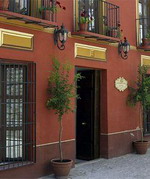 |
Hotel
Las Casas del Cónsul, Úbeda
This
17th century house, in the heart of the historic and artistic centro of
Úbeda, declared a National Heritage Site by UNESCO, has been meticulously
restored and decorated by Manuel, a loyal Rusticae customer whose experience
of visiting hotels has served to teach him how to pay attention to the
smallest of details when creating his own hotel. The building bears the
Molina coat of arms and is typical of Renaissance architecture. The décor
is classical with antiques and stuccoed ceilings of great value.
There are large windows and high ceilings and the materials used have created
a monastic atmosphere in contrast with the latest technological facilities
as if a pact had been made with the devil. The guest rooms, all with women’s
names, overlook a patio with Renaissance columns and the walls are decorated
with original art works and in some cases with stone from the Úbeda
walls. |
Continue
browsing accommodation in Ubeda
Continue
browsing accommodation in Jaén and Jaén Province
Top
|
|